If you have just picked up a hook and a skein of yarn, the tutorials online can feel overwhelming. To start, look for clear beginner guides and short projects that build confidence. Avoid information overload by choosing one reliable source rather than many. Such guides can serve as your roadmap through those first steps.
The best first projects are those that work up quickly and use basic stitches. They should forgive a few mistakes along the way to keep learning enjoyable. With steady practice, you will notice steady progress and growing control. Crochet Patterns for Beginners offers approachable projects that align with your pace.
In this guide, we are breaking down exactly what makes a pattern beginner-friendly, the essential tools you need to get started, and five incredibly easy projects you can complete this weekend. Let’s get hooking!
What Makes a Pattern “Beginner-Friendly”?
Before diving into a massive blanket, you need to know what to look for in a starter pattern. The best crochet patterns for beginners share three common traits:
- Basic Stitches Only: They rely entirely on foundational stitches like the chain (ch), single crochet (sc), and double crochet (dc).
- Simple Shapes: They are worked in straight lines (like rectangles or squares) or simple circles. No complex shaping or counting required.
- Chunky Yarn: Patterns that call for medium (worsted) or chunky yarn are ideal because they allow you to easily see your stitches and correct mistakes.
Essential Supplies You Need Before You Start
You don’t need to spend a fortune to start crocheting, but having the right tools makes the learning curve much smoother.
- Medium Weight (Worsted) Yarn: Smooth, light-colored acrylic or cotton yarn is best. Avoid dark colors (like black or navy) at first, as it makes finding your stitches very difficult.
- Ergonomic Crochet Hooks: A size H-8 (5.0mm) or I-9 (5.5mm) hook is standard for worsted yarn. An ergonomic handle will save your wrists!
- Stitch Markers: These are lifesavers for beginners to mark the beginning and end of your rows so your edges stay straight.
- A Tapestry Needle: For weaving in your loose yarn ends.
5 Must-Try Crochet Patterns for Beginners
Ready to start? These five projects are specifically designed to teach you the fundamentals while giving you a finished product you can actually use.
1. The Classic Washcloth (Mastering the Single Crochet)
The humble washcloth is the undisputed king of beginner projects. It is just a simple square, making it the perfect way to practice keeping your tension even and your edges straight. Using 100% cotton yarn will give you a durable, eco-friendly cloth for your kitchen or bathroom.
2. The Chunky Winter Scarf (Mastering the Double Crochet)
If you want fast gratification, grab some super bulky yarn and a large hook. A basic double-crochet scarf works up incredibly fast. Because the stitches are tall, the scarf grows quickly, teaching you the rhythm of crocheting without a massive time commitment.
3. The Basic Crochet Leave (Mastering Motif Shaping)
If you want to move beyond basic squares, crafting a small leaf applique is the perfect next step. It teaches you how to work on both sides of a foundation chain. Want to try it? Check out our step-by-step How to Make a Basic Crochet Leave Motif tutorial to add a botanical touch to your projects!
4. The Simple Ribbed Beanie (Mastering Texture)
Believe it or not, you do not need to know how to crochet in a circle to make a hat! One of the most popular beginner techniques is to crochet a flat rectangle using the “back loop only” technique to create a stretchy, ribbed texture. You simply fold the rectangle, seam the sides, and cinch the top closed.
5. The Magic Ring Coaster (Mastering the Round)
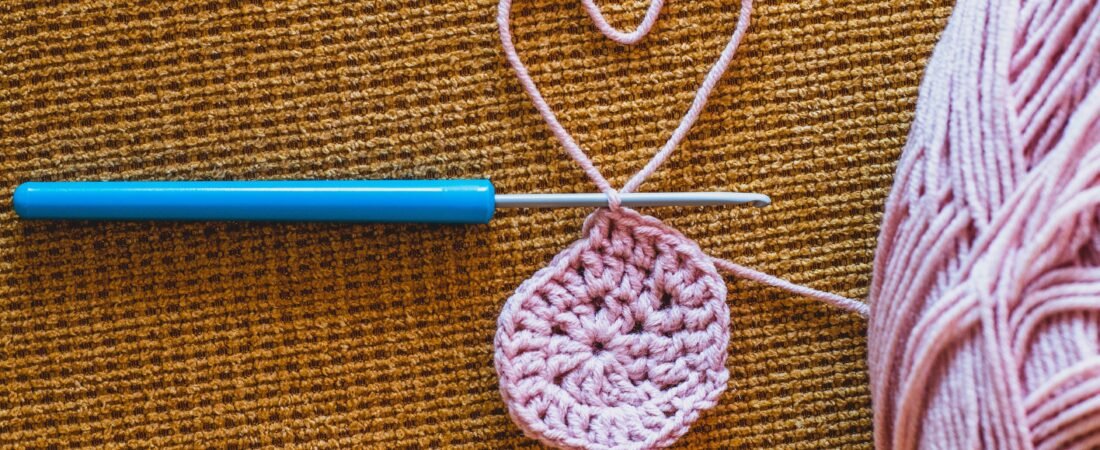
Once you are comfortable working in flat rows, it is time to learn how to crochet in the round. A basic circle coaster is the perfect low-stakes project to practice the “magic ring” technique, which is the foundation for making hats, amigurumi (stuffed toys), and baskets.