Your yarn can look perfect in the ball and still make fabric that’s too stiff or too loose. Choosing the right crochet hook size starts with the pattern and yarn label, but a test swatch confirms what works.
Your tension and the fabric you want both affect that choice. Start with the suggested size, then check how your stitches feel and measure.
Choose a Crochet Hook Size Using Yarn Weight
If you’re following a pattern, begin with its recommended hook and yarn weight. The designer chose that combination for a particular fabric and gauge, which means the number of stitches and rows within a measured area.
Without a pattern, check the yarn label for a suggested crochet hook size. Keep in mind that knitting needle recommendations aren’t crochet hook recommendations.
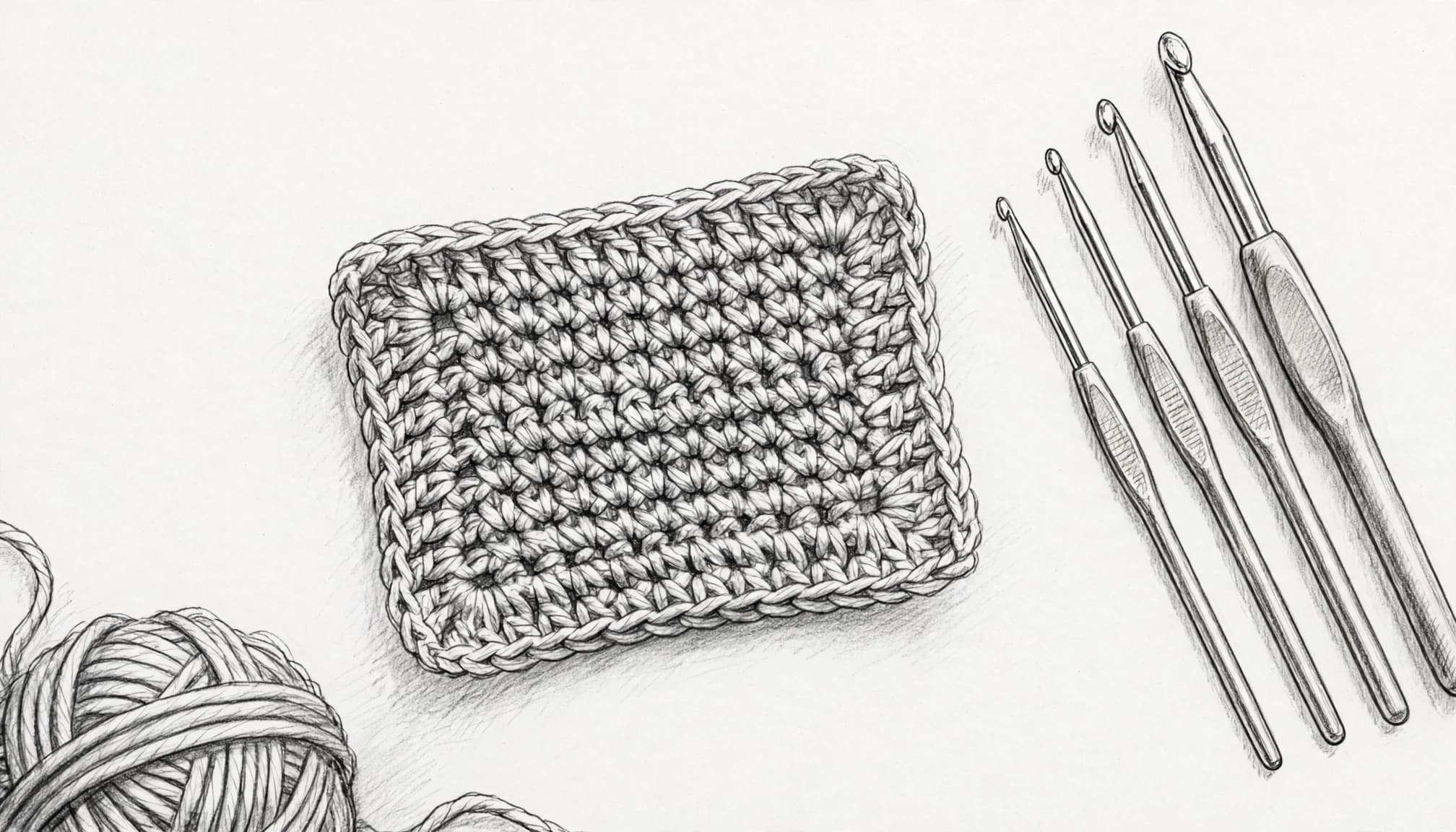
The Craft Yarn Council’s yarn-weight guidelines provide these starting ranges.
| Yarn category | Weight name | Suggested crochet hook |
|---|---|---|
| 1 | Super fine | 2.25 to 3.5 mm |
| 2 | Fine | 3.5 to 4.5 mm |
| 3 | Light | 4.5 to 5.5 mm |
| 4 | Medium | 5.5 to 6.5 mm |
| 5 | Bulky | 6.5 to 9 mm |
| 6 | Super bulky | 9 mm and larger |
| 7 | Jumbo | 15 mm and larger |
These ranges aren’t rules. A pattern may recommend a hook outside them because it needs tighter stitches or a more open fabric. Category 0, lace, often calls for steel hooks; the suitable size depends on the thread and project.
Also, two yarns in the same category won’t necessarily behave alike. Fiber and yarn construction affect the fabric, so treat a substitution as a reason to swatch again.
Read Hook Sizes in Millimeters
Hook packaging can show a letter, a number, or both. Before comparing two hooks, find their millimeter measurements.
Regular hooks: Check the diameter
The millimeter size describes the hook’s shaft diameter, which helps determine stitch size. A larger diameter generally makes larger stitches when you keep the yarn and tension consistent.
Common US equivalents include H-8 at 5 mm, I-9 at 5.5 mm, and J-10 at 6 mm. However, the Craft Yarn Council’s hook-size guidance notes that letter and number labels can vary between manufacturers. Match the millimeter marking rather than relying on the letter alone.
Steel hooks: Watch the reversed numbering
Steel crochet hooks generally handle crochet thread and fine lace work. Their numbered sizing system runs in the opposite direction: a higher steel-hook number means a smaller hook.
That makes a steel size 8 different from a regular H-8 hook. When a thread pattern lists only a numbered steel size, check the manufacturer’s metric measurement before choosing your tool. Don’t assume the number means millimeters.
Match the Hook to the Fabric You Want
Gauge matters, but so does how the finished fabric behaves. A scarf needs different qualities than a stuffed toy, even when both use the same yarn weight.
Dense fabric for amigurumi and structured pieces
For amigurumi, look for stitches close enough to keep stuffing from showing through. A smaller hook often helps, although pulling every stitch tight can make crocheting uncomfortable.
Baskets and other structured projects also benefit from fabric that holds its shape. However, if inserting the hook becomes a struggle, your fabric may be too tight. Try the next larger size and compare the result.
For a fitted hat, keep the pattern’s gauge in view. Changing the crochet hook size also changes the finished measurements.
Softer fabric for scarves and garments
Scarves, shawls, and many garments need fabric that bends and hangs comfortably. A larger hook generally creates more space between stitches, which can improve drape.
However, bigger isn’t automatically better. Excessively loose stitches can leave unwanted gaps or make the fabric lose its shape. Crochet a sample, then hold it up and fold it. Check whether it moves the way you want before committing to a whole project.
For garments, judge both drape and gauge. Attractive fabric won’t compensate for a sweater that doesn’t fit.
Test Your Gauge Before Starting the Project
A hook recommendation can’t account for your personal tension. Two crocheters using identical supplies can produce different measurements, so measure your own stitches.
The Craft Yarn Council’s swatching advice also warns against treating yarn-weight categories as an interchangeability chart. Matching the category alone doesn’t guarantee matching gauge.
Use this process when your pattern gives a gauge:
- Crochet a sample in the specified stitch pattern, making it larger than the area you’ll measure.
- Follow any washing or blocking instructions, then let the swatch dry completely.
- Lay it flat without stretching it and count stitches and rows across the stated distance.
- Change hook size if needed, then make and measure another sample.
If you count more stitches than the pattern requires across the same width, your stitches are too small. Try a larger hook. If you count fewer stitches, try a smaller hook.
For example, against a target of 14 stitches across 4 inches, a count of 16 calls for a larger hook. A count of 12 calls for a smaller one.
Check row gauge too, particularly for clothing. If stitch gauge matches but row gauge doesn’t, don’t keep changing hooks blindly. Recheck your stitch technique and follow any pattern guidance for adjusting length.
Keep using the same hook once you’ve matched gauge. Switching tools midway adds another variable to your tension.
Choose With Confidence, Then Keep the Hook Consistent
The right crochet hook size produces the fabric and measurements your project needs. Yarn labels and charts give you a starting point; your swatch gives you the evidence.
Before beginning, compare the pattern recommendation, check the millimeter size, and test the fabric. Those few minutes can save you hours of undoing stitches later.