
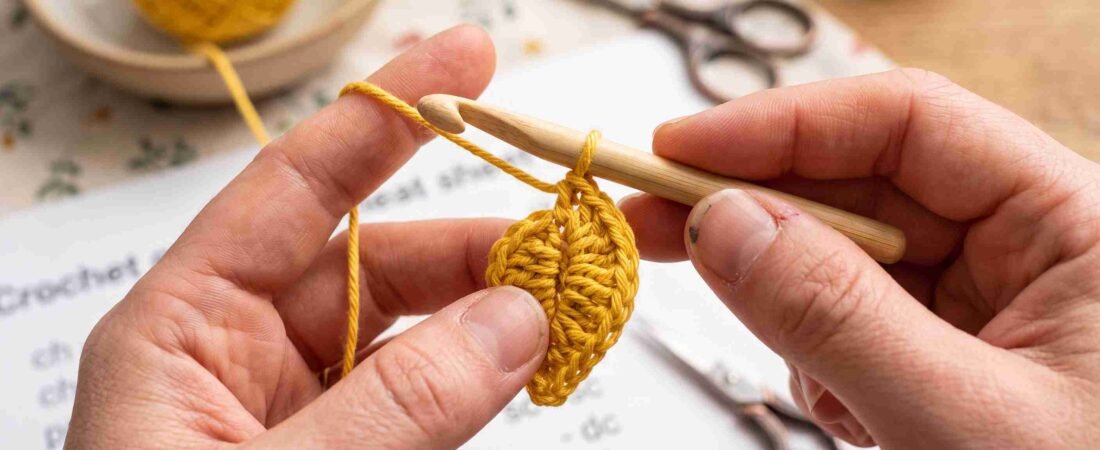
Learn how to read a crochet pattern with this complete beginner’s guide. We decode abbreviations, asterisks, brackets, and stitch counts step-by-step.
Learning how to read a crochet pattern for the first time can feel like trying to decipher an ancient, secret language. A simple instruction can look like a random jumble of letters and math symbols: Ch 2, [1 dc, 1 ch, 1 dc] in next st, rep from * around.
However, this shorthand is designed to make patterns shorter, cleaner, and easier to follow once you understand the basic mechanics. This guide breaks down every element of pattern reading, from stitch counts to those confusing brackets, so you can pick up any hook and start stitching with confidence.
The Anatomy of a Crochet Pattern
Before you get to the actual stitches, every well-written pattern begins with a foundation section. This is your preparation zone.
- Skill Level: Usually rated from Beginner to Experienced.
- Materials/Yarn: Specifies the yarn weight (e.g., Worsted Weight/Category 4) and the yardage required.
- Hook Size: Listed in letters, numbers, or millimeters (e.g., Size H / 5.0mm).
- Gauge: A small test swatch measurement (e.g., 4 in x 4 in = 12 sc and 14 rows) that ensures your finished project will be the correct size.
- Notes: Crucial pattern-specific rules, such as whether the turning chain at the beginning of a row counts as a stitch.
Decoding the Abbreviations (Free Cheat Sheet)
To save space, pattern designers use standard abbreviations for stitches. The US and UK have different crochet terms; most standard modern patterns default to US terms.
Standard US Crochet Abbreviation Cheat Sheet
(Tip: Screenshot or print this table for quick reference)
| Abbreviation | Full Term | Description |
| ch | Chain | The foundational stitch linking loops together. |
| sl st | Slip Stitch | Used to join rounds or move yarn without adding height. |
| sc | Single Crochet | A tight, compact stitch. |
| hdc | Half Double Crochet | Slightly taller than a single crochet. |
| dc | Double Crochet | A tall, open stitch commonly used in granny squares. |
| tr | Treble (Triple) Crochet | An extra-tall, loose stitch. |
| st(s) | Stitch(es) | Refers to the loops you are working into. |
| inc / dec | Increase / Decrease | Adding or subtracting stitches to shape the fabric. |
| sk | Skip | Bypassing the next stitch without working into it. |
| rnd | Round | Working in a continuous circle. |
Cracking the Code: Asterisks, Brackets, and Parentheses
Crochet involves a lot of repetition. Instead of writing “single crochet, double crochet, single crochet, double crochet” twenty times, designers use punctuation.
1. Asterisks (*)
Asterisks indicate a sequence that needs to be repeated.
- Pattern says:
*1 sc in next st, 2 sc in next st; rep from * to end. - Translation: Work one single crochet, then an increase. Repeat that exact two-stitch sequence over and over until you run out of stitches in the row.
2. Brackets [ ]
Brackets are used for two main reasons: to group stitches that all go into the exact same space, or to indicate a larger repeated section.
- Pattern says:
[1 dc, ch 2, 1 dc] in the next st. - Translation: Put everything inside the brackets into one single stitch to create a V-shape or a corner.
3. Parentheses ( )
Parentheses function similarly to brackets for grouped stitches, but their most important job is at the very end of a line.
- Pattern says:
Row 1: Ch 1, sc in each st across. (15 sts) - Translation: The number in parentheses at the end is your stitch count. When you finish the row, you should have exactly 15 stitches. Always count them before moving to the next row to prevent mistakes from compounding.
Walkthrough: Translating a Sample Pattern
Let’s put all the elements together with a simple coaster pattern.
The Pattern:
Row 1: Ch 11.
Row 2: Sc in 2nd ch from hook and in each ch across. Turn. (10 sts)
Row 3: Ch 3 (counts as 1 dc), sk first st. *[1 dc, ch 1, 1 dc] in next st, sk 1 st; rep from * across to last st, 1 dc in last st. (10 dc, 4 ch-1 spaces)
The Translation:
- Row 1: Create a starting chain of 11 loops.
- Row 2: Skip the chain closest to your hook. Put one single crochet in the next chain, and one in every chain until the end. Flip your work over like turning the page of a book. You now have a base of 10 stitches.
- Row 3: Chain 3 times (pretend this chain is your first double crochet of the row). Skip the very first stitch of the row below. Now, do the asterisk sequence: put a double crochet, a chain one, and another double crochet all into the same stitch. Skip the next stitch. Repeat that sequence until you reach the end of the row, then put one double crochet in the very final stitch. You should finish with 10 double crochets and 4 chain spaces.
Putting It Into Practice
The best way to master pattern reading is to start small. Massive blankets can be overwhelming when you are first deciphering the terminology. Smaller, repetitive motifs allow you to memorize stitch combinations and see how the written abbreviations translate into physical shapes.
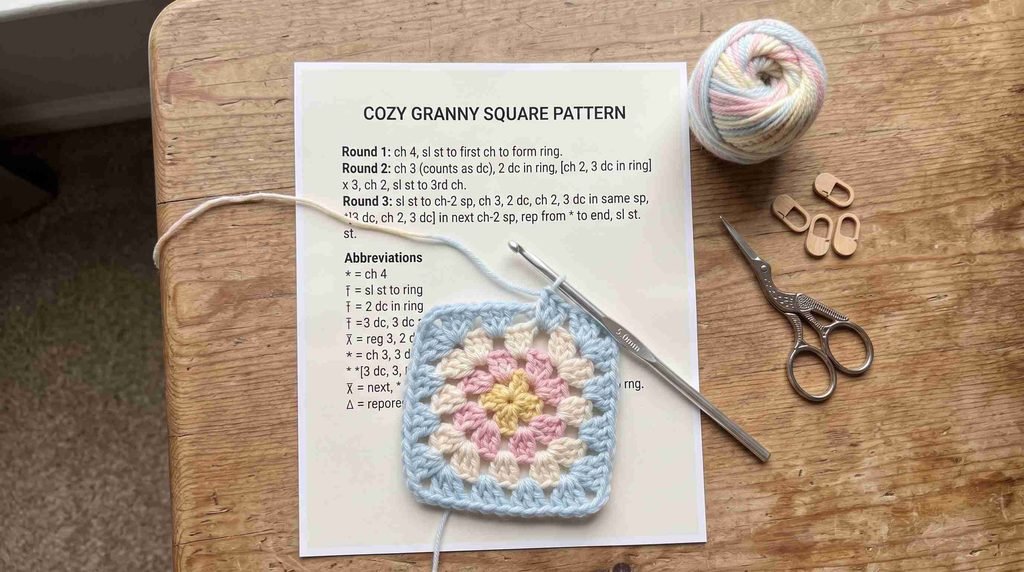
The beginner-friendly tutorials over at Lux Crochet especially the simple leaf motifs and basic granny squares—are perfect low-stakes projects for this. They allow you to practice reading standard formatting while immediately seeing the structure form in your hands. Grab your hook, keep your cheat sheet close by, and take it one stitch at a time.